Sixth Form Dress Code
Students are expected to dress appropriately and professionally in the school environment and to respect the whole school community.
Expectations
Heckmondwike Grammar School is a busy professional working and learning environment. Students are expected to dress appropriately and professionally and be sensitive to the broad range of people that they may come into contact with each day. The school community is culturally diverse and includes children as young as eleven, together with adults and visitors. Students are therefore expected to dress appropriately for a professional educational environment and to ensure that their clothing is suitable for a diverse school community.
The way we dress is a form of non-verbal communication, and it is well-known that non-verbal communication can convey attitudes and meaning just as effectively as the spoken or written word. As a consequence, almost all organisations have dress codes. This dress code aims to clarify what is acceptable dress for Sixth Form students at Heckmondwike Grammar School.
HGS Sixth Form dress code
Students must wear their ID badge, on a school lanyard around the student’s neck, at all times when on the school site. This is to allow for easy identification of students and to ensure the safety of the whole school community. We reserve the right to send students home if lanyards are not worn and visible.
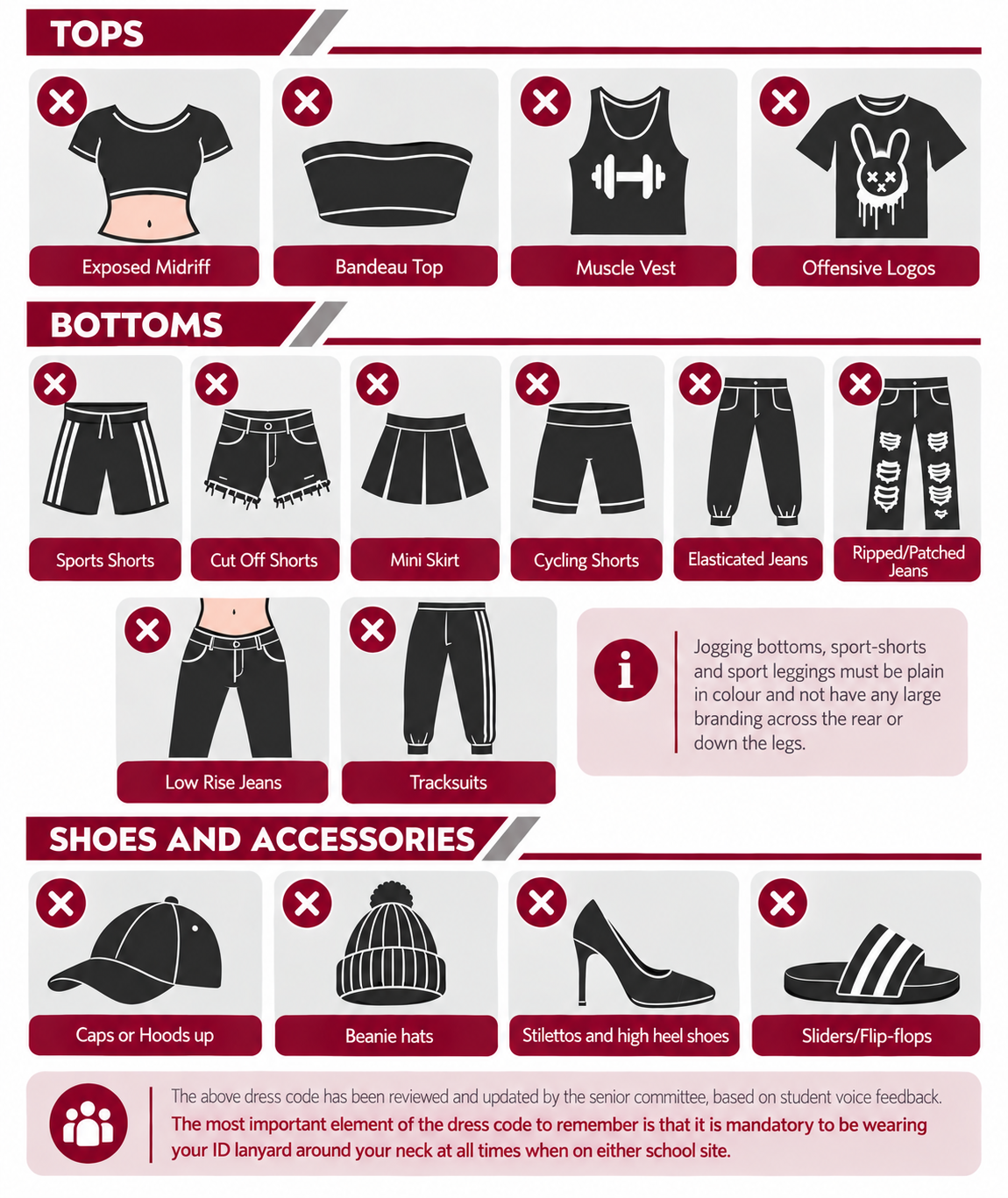
- Clothing should be appropriate for a professional educational environment and provide suitable coverage at all times. This includes ensuring that underwear, the midriff, buttocks and excessive cleavage are not visible. Clothing that is see-through or excessively revealing is not permitted.
- Students must not wear ripped jeans, ripped and patched jeans or other torn clothing.
- When wearing skirts or dresses, the length should be appropriate for a professional educational environment and provide suitable coverage when standing, walking and seated.
- Sports clothing such as sports shorts, tracksuits and jogging bottoms should be plain in colour and have no large branding.
- Leggings should be a plain muted block colour with small and subtle branding.
- Trousers should be worn so that underwear cannot be seen.
- Slogans which could reasonably be considered offensive, discriminatory, intimidating or inappropriate for a school environment are not acceptable on any form of clothing or
accessories.
- Clothing, badges, accessories and other items displaying political, campaign, protest or partisan messages are not permitted, as the school seeks to maintain an inclusive environment that is
welcoming to all members of the community.
- Hats and hoodie hoods should not be worn indoors as they can make identification of students difficult.
- Footwear must be appropriate for the school environment where corridors can be busy and crowded, floors may become slippery and there are many flights of steps. For this reason, flip-
flops and stiletto heels are considered unsafe and should not be worn.
- As the school is a busy environment, large amounts of face or body jewellery are not permitted for safety reasons.
- Hairstyles should reflect the professional nature of the school environment. Students considering a significant or unusual alteration to their hairstyle are advised to seek guidance
from the Head of Sixth Form before going ahead.
- Headphones and AirPods interfere with situational awareness and make it difficult to engage with others. Headphones and AirPods must not be worn on the main school site.
Non-acceptable clothing