Among the Nation’s Best: Students Attain Nine, Ten and Eleven Grade 9s
We are delighted to celebrate the outstanding achievements of a group of exceptional students who secured nine or more Grade 9s in this summer’s GCSE examinations.
Grade 9 is the highest grade awarded at GCSE and represents exceptional performance. To achieve one Grade 9 is a remarkable accomplishment; to secure nine, ten or even eleven Grade 9s across a range of demanding subjects is an extraordinary feat that placed 11 of our students amongst the highest-achieving young people nationally.
Their success reflects not only outstanding academic ability, but also the commitment, determination and resilience they have demonstrated throughout their studies. Consistently striving for excellence, these students have shown what can be achieved through hard work, ambition and a genuine love of learning.
As they continue their educational journey, many at Heckmondwike Grammar School Sixth Form, we congratulate them on this remarkable achievement and wish them every success for the future.
Our Sixth Form Open Evening for 2027 entry will take place on Thursday 22 October 2026 between 5pm and 8pm.
Prospective students and their parents/carers are warmly invited to attend our Sixth Form Open Evening for entry in September 2027. The evening will feature presentations from the Headteacher and the Head of Sixth Form, providing valuable insight into life at Heckmondwike Grammar School Sixth Form, our academic offer, and the opportunities available to students.
Visitors will also have the opportunity to explore departments, speak with subject staff about our wide range of A Level courses, meet current students, and discover our outstanding facilities.
- Oxbridge
- Medical Sciences
- Science, Technology, Engineering and Mathematics (STEM)
- Humanities and Arts
- Business
- Apprenticeship and Employment.
Please visit the Sixth Form area of our website for more information.
Yusuf Claims Gold in Prestigious Global Competition and Becomes First Ever UK Winner in 40 Years
Heckmondwike Grammar School is celebrating an extraordinary international success after student Yusuf was crowned International Champion at the 40th International Final of the Mathematical and Logical Games, held at the renowned Bocconi University in Milan.
Selected in May to represent the United Kingdom, Yusuf competed against some of the world’s brightest young mathematical minds on 25 and 26 July. The prestigious competition attracted national finalists from more than 20 countries, with Yusuf entering the highly competitive C1 category, the largest age group in the event, featuring 88 exceptional competitors.
Over two intense days of competition, participants were challenged to solve 22 exceptionally demanding mathematical and logical problems under strict time pressure. Each day, competitors faced 11 problems with just two hours to complete them, with solving time used to separate those achieving the same score.
Yusuf delivered a truly remarkable performance from the outset. On the first day, he solved every problem correctly and completed the paper in an astonishing 73 minutes, placing him at the top of the leaderboard. Although 12 other competitors also achieved full marks, Yusuf’s speed gave him the overnight lead in what remained an incredibly close contest.
With the title hanging in the balance, Yusuf entered the second day knowing that another perfect score would likely be required to secure victory. Rising superbly to the challenge, he once again solved all 11 problems correctly and completed the paper in an incredible 47 minutes, making him the fastest competitor across both days of the competition.
The tension culminated at the awards ceremony in Bocconi University’s main auditorium, where the top ten competitors were called onto the stage in reverse order. As anticipation built, Yusuf was announced as the International Champion, earning the Gold Medal and first place in the official C1 category.
The final results underline just how impressive his achievement was. Yusuf achieved a flawless score of 22 out of 22, solving every problem correctly and finishing 34 minutes ahead of the runner-up, despite both competitors achieving full marks.
His victory is not only a personal triumph but also a landmark moment in the history of the competition. Yusuf has become the first participant from the United Kingdom ever to win a Gold Medal in the official C1 category during the event’s 40-year history.
This exceptional accomplishment reflects Yusuf’s outstanding talent, dedication, resilience and passion for mathematics. It is also a testament to the support and encouragement he has received throughout his journey at Heckmondwike Grammar School.
We are immensely proud of Yusuf’s historic achievement and congratulate him on representing both the school and the United Kingdom with such distinction on the world stage. His success serves as an inspiration to aspiring mathematicians across the school and demonstrates what can be achieved through hard work, determination and a love of learning.
Congratulations, Yusuf, on an incredible achievement and a place in mathematical history.
Heckmondwike Grammar School is celebrating a highly successful Ofsted inspection after inspectors judged the school to be operating at a Strong Standard in six key areas, with Safeguarding Standards Met and the remaining area, Post-16 Provision, judged to meet the Expected Standard.
The inspection report highlights the exceptional quality of education, behaviour, leadership and personal development across the school, while recognising leaders’ continued determination and ambition to further improve wherever possible.
Areas Judged Strong Standard
- Achievement
- Attendance and Behaviour
- Curriculum and Teaching
- Inclusion
- Leadership and Governance
- Personal Development and Wellbeing
All safeguarding standards were also found to be fully met.
Inspectors Praise High Achievement and Ambition
Inspectors recognised the school’s outstanding academic culture, noting:
“Pupils across the school achieve highly. They thrive meeting the high levels of academic challenge that the school provides them.”
The report highlights that pupils develop “detailed knowledge over time” and produce “very high-quality work” across a broad range of subjects. Inspectors also noted that GCSE results are “among some of the best nationally”, including for disadvantaged pupils.
Ofsted also praised the school’s ambitious curriculum and expert teaching:
“Teachers have excellent subject knowledge. They bring this knowledge to life in classrooms through high-quality teaching.”
A School Where Pupils Flourish
Inspectors found that pupils are proud of their school, enjoy learning and rise to the school’s high expectations. In one of the report’s most powerful statements, Ofsted said:
“Pupils are proud to come to this school. They know that the school staff have very high ambitions for them, and pupils rise to these high expectations.” The report also recognises the school’s distinctive ethos, stating:
“The school’s traditional motto, ‘nil sine labore’, or ‘nothing without work’, is reflected in the school’s values of respect, responsibility and excellence.”
Inspectors found behaviour to be exemplary, noting that pupils “behave calmly and respectfully”, show “high levels of self-discipline” and that incidents of serious misbehaviour are rare.
Exceptional Opportunities Beyond the Classroom
The inspection celebrates the breadth of opportunities available to students through the school’s extensive enrichment programme. With over 100 clubs and activities available, many led by pupils themselves, inspectors recognised the significant opportunities for leadership, sport, music, drama and wider personal development.
Headteacher, Peter Roberts, said:
“We are absolutely delighted with this report and immensely proud of our students, staff, governors and wider school community. The inspection reflects the culture of high expectations, hard work and care that exists throughout Heckmondwike Grammar School”.
“To be recognised as operating at a Strong Standard in six areas is a tremendous achievement, and we understand places the school in approximately the top 10% nationally of schools inspected under the new Ofsted framework. We are particularly pleased that inspectors recognised the exceptional quality of teaching, pupils’ outstanding attitudes to learning, our inclusive culture and the extensive opportunities available beyond the classroom”.
“The report reflects our motto, ‘Nil Sine Labore’ – Nothing Without Work – and celebrates the commitment and dedication shown by our students every day”. “Additionally, our unofficial motto, of ‘work hard and play hard’, was very clearly exemplified, by the exceptional work students produce and their immersion in the myriad of extra-curricular activities on offer”.
“While we are proud of what has been achieved, we remain committed to continuous improvement and ensuring every student can fulfil their potential.”
The report concludes that pupils leave Heckmondwike Grammar School very well prepared for future education, employment and life beyond school.
The full report can be found here.
Congratulations to all our students on achieving outstanding GCSE results again this year. Students are once again to be congratulated for their outstanding successes at GCSE. 80% of grades were awarded at grade 7 or above, and of these 37% were grade 9.
As well as some overall excellent results for the school, with 100% of our Year 11 students securing at least five good GCSE grades, there were also 89% of our students who achieved five or more GCSEs at grade 9-7. In addition, 73% of our Year 11 students secured an impressive eight or more GCSEs at grade 9-7.
There are also some exceptional individual stories. Hafsah Asim achieved an outstanding 11 GCSEs at grade 9. Hafsa Hussain and Mazin Murrad Abdullahi Ahmed Mohammed who each achieved ten GCSEs at grade 9, alongside an A in Additional Maths FSMQ. Meghna Menon not only achieved ten GCSEs at grade 9 and an A in Additional Maths FSM, but was also the highest performer in OCR’s GCSE Design and Technology this summer. Shivani Harikrishnan and Neel Sagar Mehendale each achieved ten GCSEs at grade 9. Adam Ahmed Baporia, Krishita Dash, Eeshan Upasani and Swarit Sahu, each achieved nine GCSEs at grade 9 and an A in Additional Maths FSMQ, while Daveena Kaur Garcha achieved nine GCSEs at grade 9. These are exceptional achievements, and we congratulate all of them on their results.
These excellent results do not just happen automatically. They are evidence of the exceptional commitment and determination of Heckmondwike’s students who received outstanding support from the dedicated staff and hugely supportive parents.
Some impressive overall statistics include:
- 640 grades awarded were grade 9.
- 92 students with ten or more 9-7 grades
- 151 students with eight or more 9-7 grades
- 184 students with five or more 9-7 grades
Congratulations and well done to you all.
Congratulations to all our students on achieving outstanding A level results again this year.
As always the profile of our grades shows a very strong bias towards the upper range of grades. 85% of the A Level results were at grade C or better and 80% of these grades were either A*, A or B.
There were 261 A* and A grades altogether, including 49 students that achieved 3 or more grade A* or A passes. Among these outstanding results, and including the Extended Project Qualification (EPQ), extra special mentions go to Samhita Santosh, who achieved 5 A* grades, and to Owen Clayton, Hareem Ghouri, Sheikh Usman Imran, Yahya Variava and Taveesha Vashishta who achieved 4 A* grades. Further congratulations go to Catherine Fan, Rachel Gan, Alexander Hainsworth, Jaabir Mamaniat and Ayaana Zamir who achieved an incredible A* grade in 3 A Level Subjects.
These superb results reflect the hard work and dedication of our students and staff, and will enable the students to take their next steps with confidence. The outcomes in terms of students being placed at universities and high calibre apprenticeships of their choice are exceptionally good this year.
On Sunday, 21 June, a group of staff and students came together to take part in the Run for Jo, marking the 10th and final event in honour of Jo Cox, our former Head Girl. The event was a great celebration, bringing our community together to recognise Jo’s legacy and the lasting impact she has had on so many.
Participants had the choice of a challenging 6.5k cross country run or a more relaxed 2.5k family fun run, ensuring that everyone—regardless of age or ability—could be involved. From determined runners tackling the full course to families and friends enjoying the shorter route, the atmosphere was full of encouragement, pride, and togetherness. Staff and students alike showed tremendous commitment and spirit, supporting one another every step of the way.
As this was the final Run for Jo, it held special significance. While it marked the end of a much-loved annual event, it also served as a powerful reminder that Jo’s legacy lives on through the community.
We are incredibly proud of everyone who took part and grateful to those who supported the event. It was a fitting tribute to Jo, and a memorable way to celebrate everything Jo stood for.
On Monday 8th June, Sienna Xu and Abdul Cheema in year 8 together with Aarush Maniyar and Yusuf Shah in year 9 represented the school at the National Finals of the UKMT Team Maths Challenge in Manchester. There were seventy-two teams from all around the Great Britain as well as some representing China. We arrived in a salubrious hotel Ballroom to find a sea of desks and an atmosphere of high excitement. 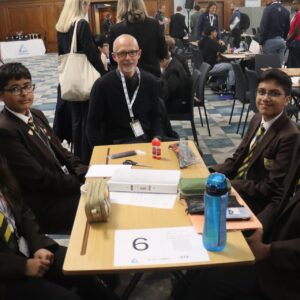
The competition was in five rounds. This year, the Poster round tasked students with researching Japanese Temple Geometry in the week leading up to the event then creating a poster on the day to include various information and answers to three unseen questions.
The other rounds followed the same format as in the Regional Finals. Our four brave competitors excelled in the early rounds, maintaining a near perfect score, then aced the group and shuttle rounds. The team had been making friends during the day and had worked out who their main rivals were but we knew nothing of the marks awarded for the poster round, so it was still all to play for!
The relay is a frenetic maelstrom of mathematics. Team members “walked quickly” from desk to desk to marker in a race to the finish. The HGS team had wings on their feet and excelled in this round. After it was all over, we were full of confidence and the team felt sure they were in with a chance of winning, especially as their poster was one of those chosen for display at the event. For those interested, the poster will soon be hanging proudly on display somewhere in school.
The results! Firstly, the poster competition – we came THIRD! Brilliant! Finally, the overall competition. Out of over 600 schools nationally, HGS came SECOND! What an amazing result!
The team are over the moon and rightly very pleased with themselves. Their hard work and tremendous collaboration definitely paid off and the team promise to be back next year. A massive thank you to Mr Robinson who coached the team in the lead up to the finals and to Mr Leitch for accompanying the team on the day.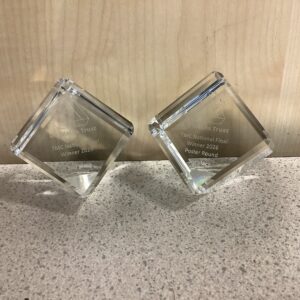
We are pleased to invite prospective students currently in Year 5, together with their parents, to attend one of our Open Evenings. The evenings offer a valuable opportunity to explore our
excellent facilities, meet our specialist staff, and gain a real insight into life at Heckmondwike Grammar School.
There will be presentations from the Headteacher, along with informative talks outlining our admissions process. Visitors will also have the chance to tour the school, meet current students and experience the vibrant learning environment we provide.
Follow the links below to book a Headteacher Presentation or Admissions Talk.
Wednesday 17 June 2026 – Book a Headteacher Presentation & Admissions TalkThursday 18 June 2026 – Book a Headteacher Presentation & Admissions Talk
At HGS, we strive to show how Mathematics translates into real-world careers. This year, several students entered the Institute of Mathematics and its Applications annual poster competition. The 2026 theme was Maths in Medicine and Health, challenging students to illustrate the vital role maths plays in healthcare.
We are delighted to announce that two of our students were recognised for their exceptional work:
- Nikitha Chelladurai (Year 8): Winner of the Year 7–9 category for her fascinating poster on Maths in Gynaecology. Nikitha received a prize of £100.
- Navya Lingolu (Year 10): Awarded “Highly Commended” in the Year 10–13 category for her project, Can Maths Predict an Outbreak? Navya received a prize of £30.
Congratulations to both students on this fantastic national achievement!